Description
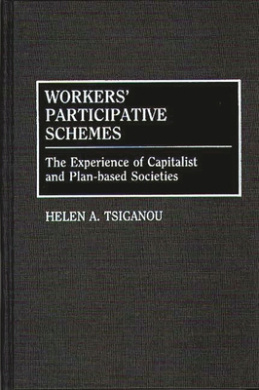
Helen Tsiganou’s study explores the enormous diversity of worker participation schemes across national contexts. Using an historical comparative approach, worker participation schemes are examined in two major settings: the developed capitalist countries of the United States, Japan, Sweden, Norway, England, Germany and France; and the centrally planned less developed socialist countries of Yugoslavia, Poland, Hungary, Czechoslovakia, China and the Soviet Union. Tsiganou addresses the conditions under which participation schemes emerge and the reasons for similarities or differences among these schemes. She first studies the origins and history of schemes within a given national setting. She then draws on specific national experiences and makes cross national comparisons. This is not a systematic, detailed, country-by-country comparison but an explanation of the enormous diversity of worker participative schemes through comparative analysis.