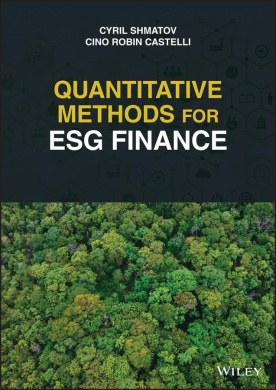
Description
Foreword 3 Introduction and Book Overview 5 1. Overview 5 2. Why ESG Finance? 5 3. Why Quantitative Methods? 6 4. Target Audience and Timing of This Book 6 5. Book Outline 7 Chapter 1. Introduction to ESG Finance 10 1.1. Preface: ESG is not a niche strategy anymore. 10 1.2. Introduction and Definitions. 12 1.3. ESG Investment Performance. 27 1.4. Sustainability and Sustainable Finance. 31 Chapter 2. Factor Investing and Smart Beta 47 2.1. Index Construction Basics 47 2.2. Smart Beta Indexes 48 2.3. Risk Factor Investing 57 2.4. Fama-MacBeth Regressions 59 2.5. Expanding the Risk Factor Universe 62 Chapter 3. ESG Ratings 65 3.1. Introduction 65 3.2. Overview of ESG Rating Methodologies 67 3.3. Regression Trees as an Alternative Scoring Technique 72 3.4. Random Forest 82 Chapter 4. Alternative Data 89 4.1. What Are Alternative Data and Their ESG Applications 89 4.2. Processing Satellite Data 96 Chapter 5. Alternative Text Data 122 5.1. Alternative Text Data on ESG 122 5.2. Corporate ESG Reports. 125 5.3. Topic Modeling 131 5.4. Latent Dirichlet Allocation 136 5.5. Outlier Topics 145 Chapter 6. Introduction to Agent-Based-Modeling for ESG Finance 147 6.1. Preface. 147 6.2. Use of Agent-Based Models in other fields and their applicability to ESG Finance. 148 Chapter 7. Climate Risk: Macro Perspective 185 7.1. Climate Change: Background Information and Definitions 185 7.2. Regulatory Response to Climate Change 208 7.3. Climate Change Modeling 214 7.4. Carbon Risk and Carbon Pricing 223 7.5. Climate Risk in Investment Practice 228 Chapter 8. Stress Testing for Banks 233 8.1. Stress Testing as a Risk Management Tool 233 8.2. Macroeconomic Stress Scenarios for Climate Risk 239 8.3. Climate Loss Modeling 250 8.4. Climate Stress Testing Exercise