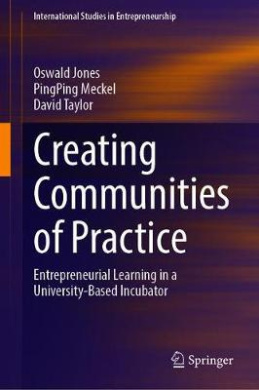
Description
1. Introduction: An Overview of the Research 1.1 Introduction 1.2 The Study of INNOSPACE 2. Business Incubation 2.1 Introduction and Background 2.2 Definitions of Business Incubation 2.3 Examining Business Incubation 2.4 University-Based Incubation (UBI) 2.4.1 UBIs and the Management Team 2.5 Summary 3. Entrepreneurship, Opportunities and Entrepreneurial Learning 3.1 Introduction 3.2 Defining Entrepreneurship 3.2.1 Defining Opportunity Identification 3.2.2 Prior Knowledge 3.3 Perspectives on Entrepreneurial Learning 3.3.1 Entrepreneurial Learning 3.3.2 Experiential Learning Theory 3.4 Entrepreneurial Learning in the Context of an Incubator 3.4.1 Learning in Communities of Practice 3.4.2 A Learning Model 3.5 Summary 4. Research Methods 4.1 Introduction 4.2 Researching Entrepreneurship 4.3 Research Approach 4.3.1 The Case Study Organisation 4.4 Interviews with Incubatees and the Management Team 4.5 Data Analysis 4.6 Summary 5. The INNOSPACE Experience 5.1 Introduction 5.2 Six Individual Pathways 5.2.1 Andy’s Experience: INNOSPACE as a Transitional Phase 5.2.2 Jane’s Experience: INNOSPACE Separating Work and Home 5.2.3 Ian’s Experience: INNOSPACE as a Physical and Social Space 5.2.4 Tony’s Experience: INNOSPACE as a Talent Pool 5.2.5 Paul’s Experience: INNOSPACE as Resource Repository 5.2.6 Kath’s Experience: INNOSPACE as a Driver of Entrepreneurial Spirit 5.3 Analysis: The Incubation Process 5.3.1 Pathways through INNOSPACE 5.3.2 Business Support 5.3.3 The Social Aspects of Business Incubation 5.3.4 Collaboration between Tenants 5.4 Summary 6. The Role of Prior Knowledge in Opportunity Identification 6.1 Introduction 6.2 Prior Knowledge 6.2.1 Prior Knowledge of Markets 6.2.2 Prior Knowledge of Customer Problems 6.2.3 Personal Interests 6.2.4 Prior Knowledge of Markets and Customer Problems 6.2.5 Prior Knowledge of Markets and Means to Serve Markets 6.2.6 Prior Knowledge of Markets and Personal Interests 6.2.7 Prior Knowledge of Customer Problems and Means to Serve Markets 6.2.8 Prior Knowledge of Markets, Customer Problems & Means to Serve Markets 6.2.9 Prior Knowledge of Markets, Customer Problems & Personal Interests 6.3 Analysis: Prior Knowledge and Opportunity Identification 6.3.1 Stream 1: Change and Innovation 6.3.2 Stream 2: Knowledge Transfer 6.3.3 Stream 3: Knowledge Replication 6.4 Summary 7. Learning and Opportunity Development in INNOSPACE 7.1 Introduction 7.2 Opportunity Development and Entrepreneurial Learning 7.2.1 Andy: Learning about Customer Problems 7.2.2 Jane: Learning New Business Skills 7.2.3 Ian: Learning about Networking 7.2.4 Tony: Learning how to Serve Customers 7.2.5 Paul: Learning about Markets 7.2.6 Kath: Learning from Others 7.3 Analysis: Entrepreneurial Learning and Opportunity Development 7.3.1 The Exploitation of Prior Knowledge 7.3.2 Transformation of Identity and Opportunities 7.3.3 Acquisition of Skills and Competencies 7.4 Summary: The INNOSPACE Learning Community 8. Discussion: The INNOSPACE Community of Practice 8.1 Introduction 8.2 Entrepreneurial Learning and Business Incubation 8.2.1 The Business Incubation Process 8.2.2 Entrepreneurs, Prior Knowledge and Opportunity Identification 8.2.3 Entrepreneurial Learning in a Business Incubator 8.3 Reconceptualising Entrepreneurial Learning and Opportunity Development 8.3.1 INNOSPACE as a Community of Practice 8.4 Summary 9. Conclusion: Contribution, Implications and Future Research 9.1 Introduction 9.2 Contribution to Knowledge 9.3 Implications of the Research 9.3.1 Implications for Incubation Managers (IM) 9.3.2 Implications for Prospective and Existing Incubatees 9.3.3 Implications for Policy-makers 9.4 Reflexive Research Account 9.5 Summary and Future Research 10. Postscript: Creating and Managing a University-based Incubator 10.1 Introduction: Initiating INNOSPACE 10.2 The Evolution of INNOSPACE 10.3 Managing INNOSPACE 10.4 INNOSPACE: Envisioning a Community of Practice 10.5 INNOSPACE: The Move to Maturity (2014-2019) 10.6 INNOSPACE Case Studies 10.6.1 Lee McAteer: Invasion Camp Group 10.6.2 Fiona McKay: Lightbulb Leadership Solutions 10.6.3 Nick Richardson: The Insights People 10.6.4 Jamie Bettles: Pagoda Project 10.6.5 Dan Sodergren: Great Marketing Works & YourFLOCK 10.6.6 Rob Woollen: Rightway Wellbeing Ltd. 10.6.7 Summary: Building Successful Companies 10.7 Conclusion: Fulfilling the original vision?