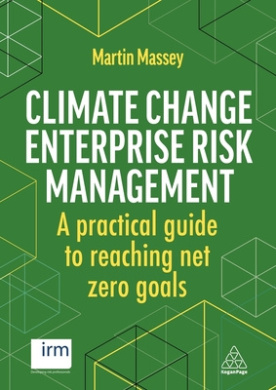
Description
Martin Massey is a leading practitioner in enterprise risk management. He has worked for some of the leading global insurance and risk consulting firms and has over 30 years of industry experience. He is the Managing Director of OneRisk Consulting Ltd, providing Enterprise Risk Management consultancy services with a focus on climate change risk management. He is Chair of the Institute of Risk Management’s (IRM) Climate Change Special Interest Group and helped to design and launch the IRM’s climate change training course, for which he acts as a trainer. He has taught Enterprise Risk management at Georgetown University in Doha. Martin wrote the IRM’s Climate Change Practitioners Guide in 2021. Clive Thompson was founding Chair of the Professional Standards and the Interest Group Committees of the Institute of Risk Management (IRM) where he was Deputy Chair until 2020. As Deputy Chair, he initiated the first seminar to focus on Climate Change at the IRM and instigated the IRM’s Special Interest Group on Climate Change. Based in West Sussex, UK, he has over 40 years of global experience in Insurance and Risk Management. He is a Certified Fellow of the IRM and of the Chartered Insurance Institute. Clive is one of the authors of the 6th version of Fundamentals of Risk Management, also published by Kogan Page. The IRM is a world leading professional body for risk management, driving excellence in managing risk to ensure organizations are ready for opportunities and threats of the future. Chapter – 00: Introduction – Climate change enterprise risk management in context; Chapter – 01: Climate change risk landscape and ERM maturity; Chapter – 02: Climate strategic positioning and risk appetite integration; Chapter – 03: Developing an effective climate governance framework; Chapter – 04: Climate change risk identification techniques including stakeholder mapping; Chapter – 05: Managing transition risks; Chapter – 06: Building climate resilience; Chapter – 07: Climate physical risks – Data sources, uses and challenges; Chapter – 08: Designing an effective climate emerging risk management process; Chapter – 09: Climate emerging trends, issues and challenges; Chapter – 10: Climate stress and scenario testing; Chapter – 11: Climate risk integration into specific business processes; Chapter – 12: Financial reporting and climate disclosures