Description
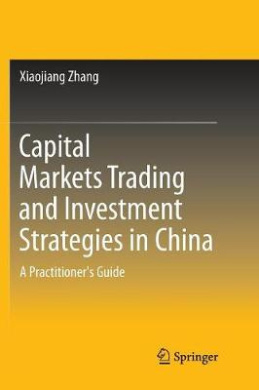
Xiaojiang Zhang, previously worked at various large global financial institutions in the areas of foreign exchange, fixed income, derivatives trading, and portfolio management. Since returning to China, the author has been working as a front office business architect in one of the largest banks. Author of Capital Markets Trading and Investment Strategies in China published by Springer in 2018. Author of Mechanical Analysis of China’s Macro Economic Structure published by Springer in 2020. Two times top economic think tank award winners. Part 1. Portfolio building blocks covering foreign exchange, money markets, fixed Income and derivatives Instruments1Traded Foreign Exchange Instrumentsa) Onshore CNY FX instrumentsi. The markets, currency pairs traded and various market convention. ii. FX Spotiii. FX Forwardiv. FX Swapv. FX Optionvi. The pricing mechanism in the onshore wholesale market and retail market.b) Offshore CNY/CNH FX Instrumentsi. The markets, currency pairs traded and various market convention. ii. Deliverable vs. NDFiii. FX forward tradeiv. FX Optionv. The pricing mechanism in the offshore wholesale and retail marketc) The capital flow and pricing transmission between Domestic CNY market and offshore CNY/CNH market2Traded Money Market Instrumentsa) Onshore CNY Marketi. Diversified participantsii. Liquidity and historical developmentiii. Short maturity dominationiv. Instruments traded1. Repo and Reverse Repo2. Loan Deposit3. Sec Lending4. Cross-border CNY financing with Loan/Dep5. CD6. MM fundv. Different MM indices: SHIBOR, Repob) Offshore FX managementi. Instruments traded1. Repo and Reverse Repo2. Loan Deposit3. Commercial Paper4. Short treasury securities5. CD6. FX Swapii. Transaction initiation channels1. Loan/Deposit with Reuters and other terminals, Broker quotes, Counterparty quotes2. FX with Reuters and other terminals, Counterparty quotes3Fixed Income Instruments market condition, pricing mechanism, quoting and settlement conventiona) Instruments by issuersi. Government Bondii. Local Government Debtiii. Policy Bank Bondiv. Commercial Paperv. Short Commercial Papervi. Central Bank Billvii. Corporate/ MTNviii. ABS.b) Instruments by cashflow structures i. Fixed rate bondii. Floatersiii. Option-embedded bondsiv. Convertiblesv. Small-and-Medium Enterprise Collective Notes (SMECN)vi. High yieldvii. Asset-Backed Securities c) Market condition and trading conventioni. Exchange, interbank, and retail marketii. Regulatory regime for the fixed income market place iii. Participants distribution for tradingiv. Investment community distributiond) Specific Interbank market vs. Exchange market differences i. Liquidity and issuanceii. Player participation and risk appetite iii. Leverage usage4Derivatives market condition, pricing mechanism, and trading conventiona) Swapsi. Instrument definition, indices and applicationii. Participants and trading liquidityb) Bond Futuresi. Contract definition and Instrument applicationii. Cheapest-to-deliver and IRRiii. On-the-run bonds Part 2. Macro Economics, Monetary Cycle, Industry Cycle, Monetary Condition, Supply and Demand5Macro cyclea) Import/Export cycle, Trade Balance, PMI Indexi. GDP and growth contribution ii. Export dependency, market distribution, surplus and TPPiii. PMI relevance, pork price and othersb) Real Estate Cycle i. New construction, sales and existing inventoryii. GDP and growth contributionc) Government-driven Investmenti. Government spending and its historyii. Budget deficit constraint and real estate-dependencyd) USD Cyclei. Global monetary condition and funding costii. Global exchange rate fluctuation and impact on commerce6Industry cyclea) Industry classification and their unique Chinese characteristicsb) State-owned vs. Private-owned7Monetary cyclea) M2 growth rate, 10 year bond yield, 7D and 1M repo rateb) M1, M2, and Total Social Financingc) Quantity vs. pricing target signal d) Monetary liquidity quantity: reserve ratioe) Monetary liquidity price target: Repo Rate8CFETS (China Foreign Exchange Trade System)9China Banking Regulatory Commission and Interbank market10China Securities Regulatory Commission and exchange markets Part 3. Applied Pricing Curve in the Market and Term Structures11Curves and Term Structuresa) FX curves and swap pointsb) Money market curvesc) Government bonds and interest rate term structured) Tax spread curve and policy bank bondse) Credit spread curve by rating and industryf) Swaps curveg) Bond future IRR, contract spread and roll-over12In-depth on factors driving onshore FX and money market curvesa) Monetary policy-driven supply policy factorsi. Reserve Ratio, Open Market Operation, Discount Windowb) Non-monetary policy-driven supply factorsi. Funds outstanding for Foreign Exchangeii. Treasury Depositc) Structural factorsi. Regulatory fund requirement complianceii. IPO and other investment flowsiii. Bank fund instabilityd) Seasonal issues and market expectationi. Consumer seasonal spending patternii. Market expectation for fund shortagee) In-depth on factors driving fixed income portfolio return and risk curve parametersi. Cross-border monetary inflow and outflowii. Domestic monetary supplyiii. Product supply and demandiv. Asset allocation effect vs. money availablev. Risk appetitevi. Cost of fundsvii. Credit allocation limits and industry policy issued by governmentviii. Bond future net basis, implied Repo Rate and Cheapest-to-Deliver conversion optionalityf) MTM basics for listed capital markets products. Part 4. Regulatory Regime and Some Policies in Focus13Central bank’s various objectives and its balance sheet analysisa) Objectives: Economic growth stability; Supply Side Reformb) Liquidity injection working mechanisms: c) SLO (Short-term Liquidity Operations)d) SLS (Standing Lending Facility)e) MLF (Mid-term Lending Facility)f) PSL (Pledged Supplementary Lending)14Foreign exchange trading regulation: mid Pricing guideline. 15Fixed income trading regulation: leverage ratio, collateral financing16ABS and its related regulation17Currency account and capital account market liberalization Part 5. Other Participants 18Fixed income institution players, market making participationa) Banks: 3-tiered banking systems, balance sheet, number of retail outlets, and cost of funding.b) Mutual fund, tax policy, and carry advantagec) Insurance companies and long investment horizond) Foreign financial institutionse) Private equities, a growing presence19FX trading players20MM players Part 6. Portfolio Objectives and Trading and Investment Strategies21Onshore CNY Liquidity Portfolio Managementa) Asset liability managementb) Reverse managementecastingd) Trading management for maturity, price, counterparty, direction, positione) Support for central open market operations22Offshore FX Liquidity Portfolio Management Strategy Objectivesa) Pricing factorsi. Level of the base rates for different maturitiesii. Market supply and demandiii. Credit conditioniv. SAFE short term foreign debt limitb) Tactical objectivesi. Tactical liquidity objectives for banksii. Position forecast and fund allocationiii. Maturity adjustmentiv. Currency position adjustmentv. Short term investmentvi. Dealing with central bankvii. Liquidity management23Trading accounts FX MTM and Strategiesf) FX Strategiesg) Trade-financed CNY CNH interest rate arbitrageh) Cross-rate wash split strategies 24Trading accounts bond strategiesi) Leveraged carrying trade on the exchange and in the interbank marketj) Bull bear duration and rating strategyk) Term spread mean-reverting strategyl) Tax spread strategy25Bond future net basis strategy and negative implied repo rate a) Net basis strategyb) Implied repo strategyc) CTD conversion strategy d) On-the-run, existing issuance and tax spread e) Domestic market’s short sale implication26Investment Accounts Objectives and Strategiesa) Some basicsb) Cost of fundc) Asset liability management objectivesd) Garden variety of portfolio objectives and investment strategies i. Return before tax and return after taxii. Newly-added investment yieldiii. EVAiv. RAROCv. Portfolio duration and risk managementvi. Sector duration and risk managementvii. Total portfolio Profit & Losse) Insurance companies long end ALM strategiesf) Mutual Fund investment, a mixed asset pool to start withg) Foreign banks’ short duration and carry tradeh) Off-balance sheet wealth investment, a 3 trillion USD and still growing sectori) Trust-based High Yield Regulatory Arbitrage strategy, a substantial sector with limited potentialj) Asset-backed securities investment, regulatory capital advantage, risk diversification, and yield enhancementk) Convertible strategy and callable implications Part 7. Risk Management Practice27Trading Accounts Limits Allocationa) FX PV01 allocationb) IR DV01 allocationc) Single transaction notional limitd) Maximum loss limit e) Maximum position limit28Investment Accounts Credit Allocation Practicea) Credit limit by counterpartyb) Credit limit by issuerc) Credit limit by lines of desk management29Investment Portfolio Term Duration Management